Why Minoxidil Shedding Is Actually a Good Sign
You start minoxidil full of hope. Two weeks later, you're watching clumps of hair fall out in the shower, and panic sets in. "The treatment is making it worse. I should quit."
The Timeline: What to Expect
Why Some People Don't Shed (And That's Not Always Better)
Not everyone experiences a dramatic shed on minoxidil. If you don't shed, it means one of two things:
- Your follicles were already in anagen when you started, so there were no telogen hairs to eject. The drug just extends the existing growth phase.
- You're a non-responder. A small percentage of users (~10-20%) lack sufficient sulfotransferase enzymes in their scalp to convert minoxidil into its active form (minoxidil sulfate). These users won't shed because the drug isn't engaging with their follicle biology at all.
The shed is often—though not always—a positive prognostic sign. It means the drug is actively resetting your follicle cycles, which is necessary for long-term regrowth.
The Critical Truth
If you quit minoxidil during the shed phase (weeks 2-8), you experience all the downside (losing old hairs) with none of the upside (growing new, thicker ones). You essentially pay the biological cost without collecting the reward. The men who succeed are those who push through weeks 4-8 when things look worst.
How to Tell If It's Normal Shedding vs. Something Else
Not all shedding on minoxidil is the beneficial "reset" type. Here's how to distinguish:
Normal Minoxidil Shed (Good)
- Begins weeks 2-4 after starting treatment
- Peaks around weeks 4-8, then gradually declines
- Hair loss is diffuse, not patchy
- Shedded hairs are thin, short, or lightly pigmented (miniaturized hairs)
- You notice "baby hairs" or peach fuzz starting to appear by week 8-12
Abnormal Shedding (Investigate)
- Shedding continues unabated past 10-12 weeks
- Hair loss is patchy or concentrated in one area (could indicate alopecia areata)
- Shedded hairs are thick, terminal hairs with intact roots
- You experience scalp pain, redness, or severe itching (allergic reaction)
- No new growth appears by month 4-6
If you're experiencing abnormal shedding, consult a dermatologist. Minoxidil can unmask underlying conditions like telogen effluvium or thyroid issues, which need separate treatment.
Stacking Minoxidil: How Finasteride Changes the Equation
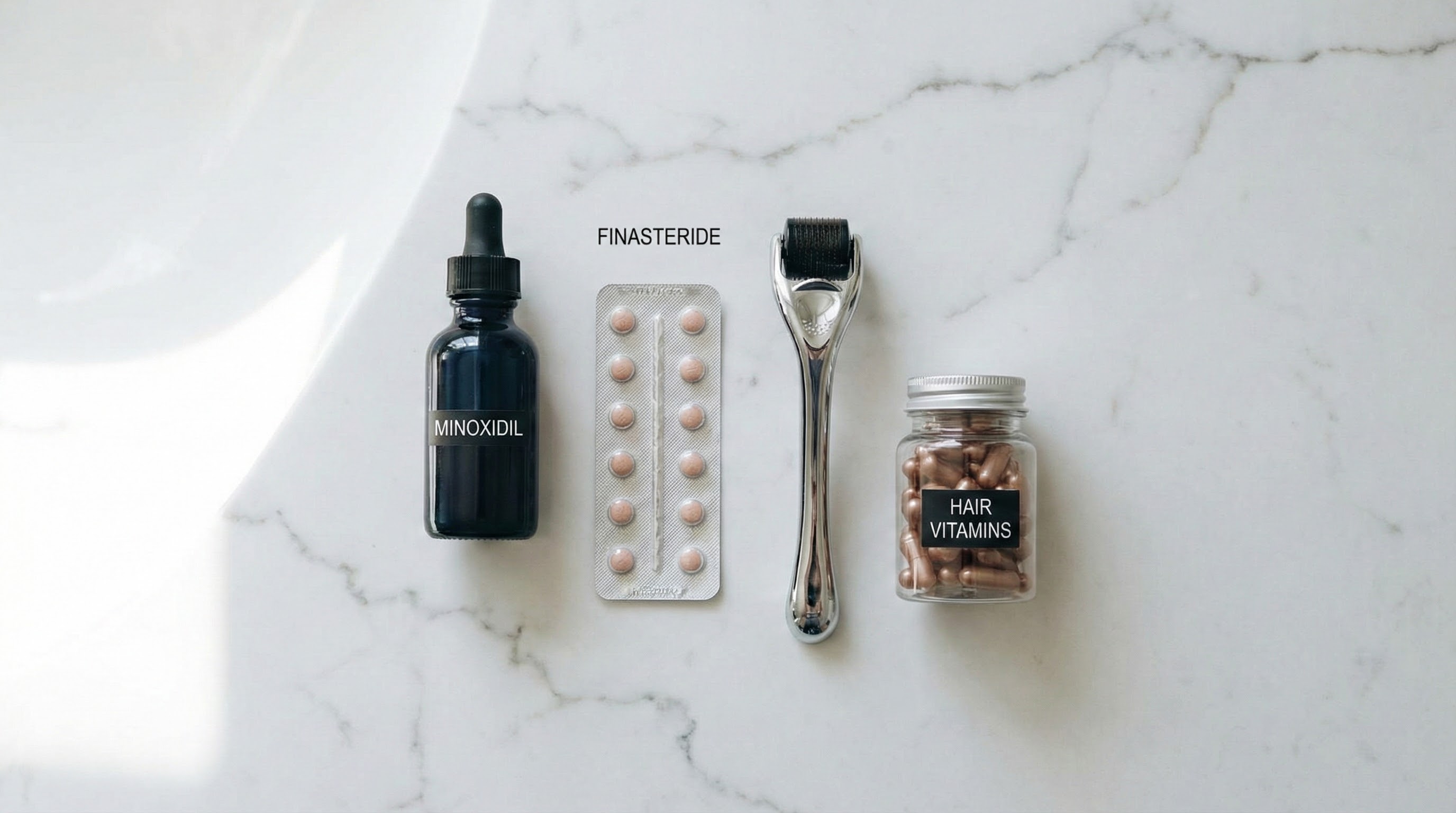
If you're using both minoxidil and finasteride, you may experience a "double shed"—one from minoxidil's cycle reset, another from finasteride's hormonal adjustment. This is actually ideal for long-term results.
Finasteride reduces DHT, which allows miniaturized follicles to produce thicker hairs. When you add minoxidil, it forces those follicles to eject the old thin hairs and start fresh with the new, DHT-protected growth environment. The combined shed can be more dramatic, but the regrowth is typically more robust.
Practical Tips for Surviving the Shed
Knowledge helps, but psychology still struggles when you're watching hair fall out. Here's how to maintain your sanity:
- Take baseline photos. On day 1, take standardized photos in consistent lighting from multiple angles. When you're at week 6 and panicking, these photos will show you that you weren't at peak density to begin with. The shed is returning you to baseline before building you back up.
- Avoid daily mirror analysis. Staring at your hairline every morning creates a negative feedback loop. Limit detailed inspection to once per week maximum.
- Track shed intensity. Count hairs in the shower for one week at baseline, then again at weeks 4, 8, and 12. This objective data counters emotional perception. You'll see the shed peak and decline, which reassures you the process is finite.
- Connect with others. Online communities (Reddit's r/tressless, HairLossTalk forums) are full of men documenting their shed-and-regrow timelines. Seeing others' progression photos normalizes your experience.
- Set a "decision date." Commit upfront to using minoxidil for a full 6 months before evaluating efficacy. Don't make decisions during the shed phase when emotion peaks.
Ready to Start Your Protocol?
Minoxidil works, but only if you commit to the full process—including the shed. Find the right formulation and protocol for your situation.
Compare Minoxidil OptionsThe Bottom Line: Short-Term Pain, Long-Term Gain
The minoxidil shed is the price of admission. You can't force dormant follicles back into active growth without ejecting the old, weak hairs they were holding onto. It's not pretty, but it's necessary.
Think of it like renovating a house. You have to tear out the old, damaged materials before you can install new, better ones. The construction phase looks worse than before you started, but the finished product is superior.
The shed is temporary—typically 4-8 weeks of increased hair fall. The regrowth, if you stick with it, is long-term. Clinical data shows that men who persist through the shed and use minoxidil consistently for 12+ months have a 60-80% chance of significant stabilization or regrowth.
The question isn't whether to endure the shed. It's whether you're willing to trade 6-8 weeks of psychological discomfort for years of improved hair density. For most men, that's a trade worth making.
- Understand the hair growth cycle that makes shedding necessary
- Learn about oral minoxidil as a convenient alternative
- Explore stacking minoxidil with finasteride
Find a Provider Who Fits Your Needs
HealthRX prescribes finasteride from $22.33/mo and topical minoxidil + finasteride from $31.33/mo (3-month plans), after review by a US-licensed clinician.
See HealthRX hair treatment →