The Hair Growth Cycle Explained: Your Follicles Are Athletes, Not Patients
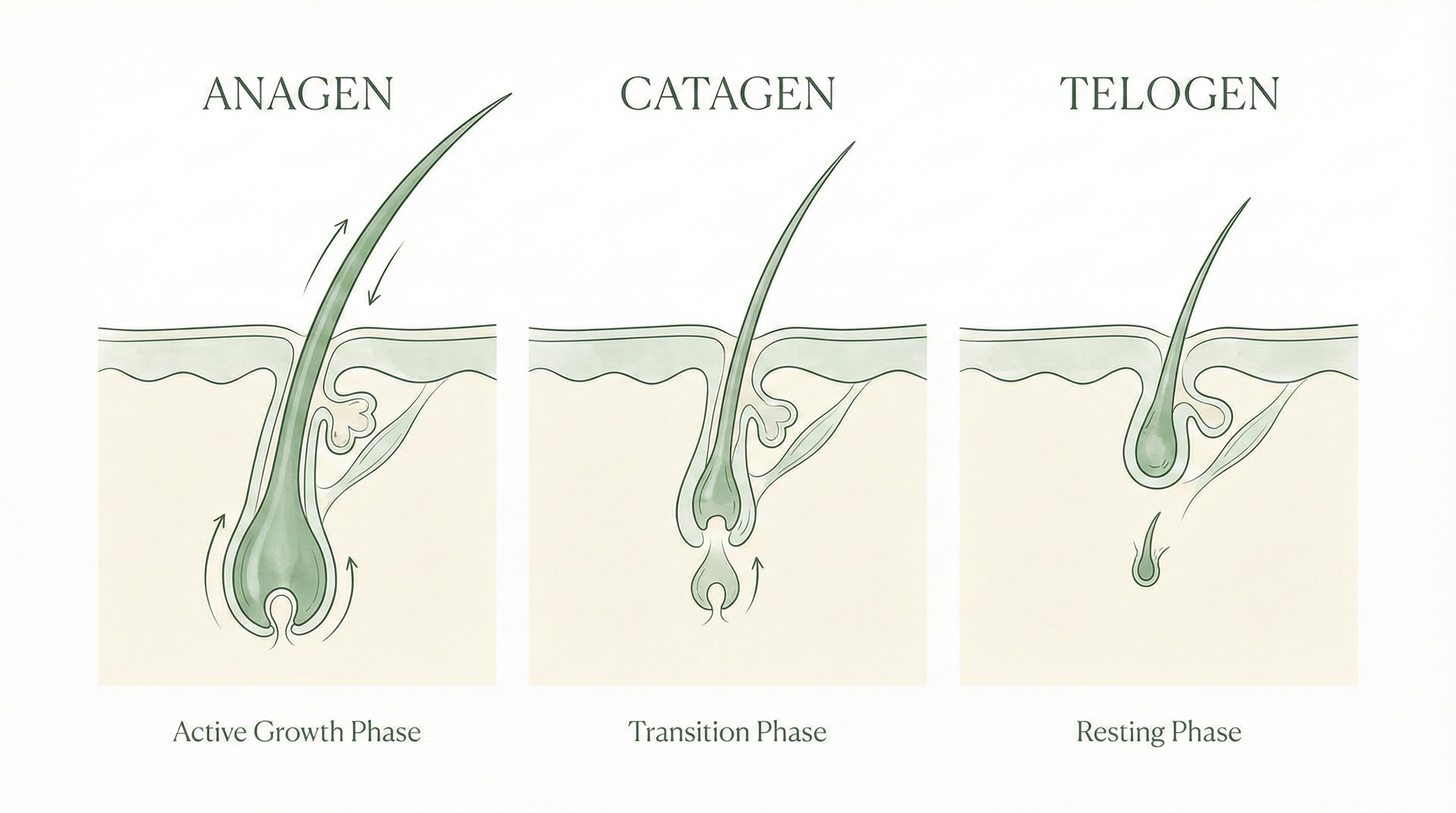
If you think of your hair follicles as passive entities that simply "grow" or "die," you're missing the entire picture. Your follicles are dynamic, cyclical systems—more like athletes moving through training phases than patients awaiting treatment.
2Catagen: The Cool-Down Phase
Duration: 2-3 weeks
What's Happening: Follicle regression, detachment from blood supply, club hair formation
Catagen is the brief transition where the follicle "turns off" active growth. The hair shaft stops elongating, the outer root sheath shrinks, and the base of the hair (now called a "club hair") begins to detach from the dermal papilla.
This is like the post-workout cool-down—the follicle is wrapping up its growth cycle and preparing for a rest period. Only about 1-2% of your follicles are in catagen at any given time, which is why you don't notice this phase unless something disrupts the cycle.
3Telogen: The Recovery Phase
Duration: 2-4 months
What's Happening: Hair at rest, follicle regenerates, preparation for next anagen
Telogen is recovery mode. The club hair sits in the follicle, held loosely in place, while the follicle itself regenerates and prepares for the next growth cycle. About 8-14% of your scalp is in telogen at any moment.
This phase is crucial for follicle health. It's when stem cells in the follicle's bulge region prepare to generate a new hair matrix. Disruption of telogen—through stress, illness, or nutritional deficiency—can cause telogen effluvium, where large numbers of hairs synchronize their cycles and shed simultaneously.
4Exogen: The Shedding Phase
Duration: Days to weeks
What's Happening: Old hair releases, new hair begins pushing up from below
Exogen is the active shedding of the club hair. As a new anagen hair begins growing beneath it, the old hair is mechanically dislodged—often during washing, brushing, or simply by the new hair pushing it out.
This is normal. Shedding 50-150 hairs per day is expected, not alarming. These are hairs that completed their lifecycle and are making room for new growth.
How Treatments Manipulate the Cycle
Understanding the cycle reveals why certain treatments work and others fail. Effective interventions target specific phases:
Minoxidil: The Anagen Extender
Minoxidil's primary mechanism is prolonging the anagen phase. It does this through potassium channel opening and increased blood flow, which essentially "tricks" the follicle into staying in growth mode longer than it otherwise would.
This is why minoxidil causes temporary shedding in weeks 2-8 of use. It's forcing dormant telogen follicles to eject their old club hairs and enter a new, synchronized anagen phase. This shedding is a sign the drug is working, not failing.
Finasteride: The Phase Protector
Finasteride doesn't directly alter the cycle phases—it protects them from DHT-induced shortening. By reducing DHT levels by ~70%, finasteride prevents the progressive anagen miniaturization that defines androgenetic alopecia.
Without DHT signaling the follicle to shut down prematurely, anagen durations gradually normalize. Follicles that were stuck in 6-month anagen cycles can return to 2-3 year cycles, producing terminal hairs instead of vellus hairs.
Microneedling: The Phase Trigger
Microneedling (dermarolling or dermapen) creates controlled micro-injuries that trigger a wound-healing cascade. This releases platelet-derived growth factors (PDGF), vascular endothelial growth factor (VEGF), and activates the Wnt/β-catenin signaling pathway.
The result: dormant telogen follicles are jolted back into anagen. Think of it as forcibly waking up a resting follicle and telling it to resume training.
Why Synchronized Shedding Happens (And Why It's Often Good)
When you start minoxidil, finasteride, or undergo a stressful event, you might experience a dramatic shed. This happens because treatments can synchronize follicle cycles.
Normally, your follicles are staggered—each on its own timeline. But when a powerful stimulus (like minoxidil) hits, it can force many follicles to reset simultaneously. They eject their old telogen hairs and enter anagen together.
The Key Insight
Shedding after starting treatment means the treatment is actively engaging with your follicle biology. It's not "making things worse"—it's rebooting the system. The old, weak hairs had to leave to make room for new, stronger ones.
This is precisely why patience is non-negotiable. You can't see new anagen hairs until they've grown 1-2cm out of the scalp, which takes 1-2 months after the shed. Full visual density takes 6-12 months because that's how long it takes for miniaturized follicles to transition through a full cycle and produce thicker terminal hairs.
The Cycle Disruption: Telogen Effluvium vs. Androgenetic Alopecia
It's critical to distinguish between telogen effluvium (TE)—a temporary cycle disruption—and androgenetic alopecia (AGA)—progressive miniaturization.
Telogen Effluvium: Triggered by stress, illness, surgery, or nutritional deficiency. Many follicles suddenly shift from anagen to telogen, causing diffuse shedding 2-3 months later. The follicles themselves aren't damaged; they're just temporarily synchronized. TE resolves on its own once the trigger is removed.
Androgenetic Alopecia: DHT-driven shortening of anagen over time. The follicle doesn't just rest—it miniaturizes, producing progressively thinner hairs. This is chronic and progressive unless treated.
Many men experience both simultaneously—AGA as the underlying condition, with TE episodes layered on top during stressful periods. This is why sudden, dramatic shedding doesn't always mean your protocol failed; it might just be TE running its course.
Ready to Optimize Your Follicle Cycle?
Understanding the cycle is step one. Step two is implementing a protocol that extends anagen, protects against miniaturization, and maximizes your follicle's growth potential.
Compare Treatment OptionsThe Bottom Line: Your Follicles Are Always Training
Your hair follicles aren't static. They're dynamic systems cycling through growth, transition, rest, and shedding—constantly. This isn't a medical condition; it's normal biology.
The problem in androgenetic alopecia isn't that the cycle exists—it's that DHT disrupts it, shortening anagen and forcing premature transitions. The solution isn't to "cure" the cycle; it's to optimize it—extend growth phases, protect against miniaturization, and trigger dormant follicles back into action.
Think of your follicles as athletes. They need fuel (blood flow), protection from injury (DHT blocking), and periodic stimulation (microneedling, massage). Give them that, and they'll perform at their peak capacity.
- Learn why minoxidil shedding is a positive sign
- Understand how finasteride protects the cycle
- Explore microneedling protocols
Find a Provider Who Fits Your Needs
HealthRX prescribes finasteride from $22.33/mo and topical minoxidil + finasteride from $31.33/mo (3-month plans), after review by a US-licensed clinician.
See HealthRX hair treatment →