Topical Finasteride: Precision DHT Blocking Without Systemic Exposure
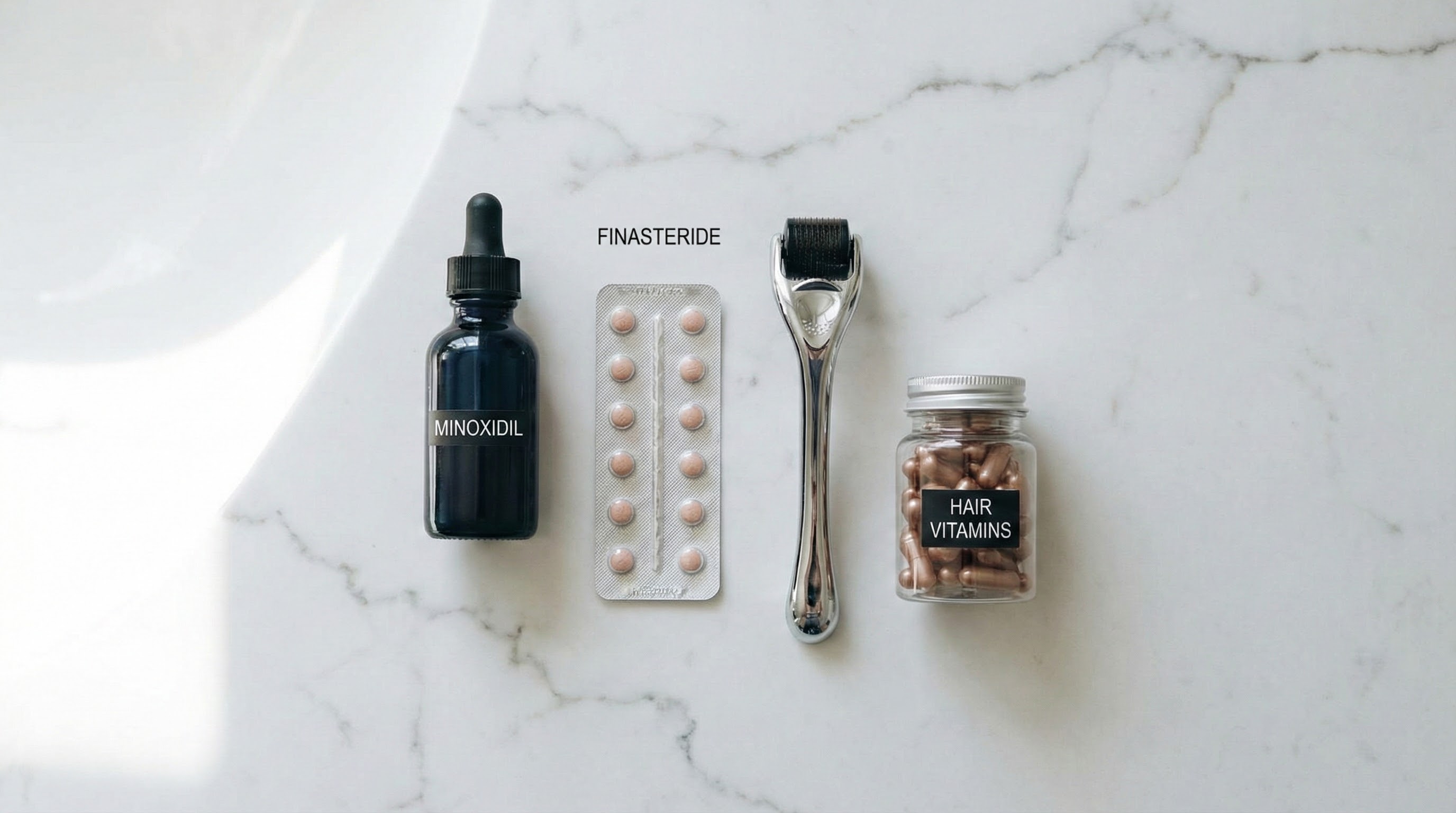
What if you could get the hair-protective benefits of finasteride while minimizing systemic DHT suppression? That's the promise of topical finasteride—a formulation designed to maximize scalp DHT reduction while limiting serum absorption.
Efficacy: Does It Actually Work?
The critical question: is topical finasteride as effective as oral for hair regrowth?
Phase III Clinical Trial Results
A large-scale randomized controlled trial comparing 0.25% topical finasteride spray to oral finasteride 1mg found:
- Hair count increase: Statistically non-inferior (both groups showed similar gains)
- Investigator assessment: No significant difference in visible improvement
- Patient satisfaction: Comparable between groups
- Side effect profile: Trend toward lower incidence in topical group (though not always statistically significant due to low baseline rates)
"Non-inferior" in clinical trial language means: topical finasteride works just as well as oral finasteride for hair regrowth. You're not sacrificing efficacy by going topical.
The Key Advantage
Topical finasteride delivers similar hair outcomes with approximately 50% less serum DHT suppression. For men who are risk-averse or experienced mild systemic side effects on oral finasteride, this is a game-changer.
Comparing Oral vs. Topical: The Trade-Offs
| Factor | Oral Finasteride | Topical Finasteride |
|---|---|---|
| Serum DHT Reduction | ~70% | ~34% |
| Scalp DHT Reduction | ~60% | ~55-60% |
| Hair Regrowth Efficacy | Gold standard | Non-inferior (equal) |
| Convenience | Very high (one pill) | Moderate (daily application) |
| Systemic Exposure | High | Lower (~50% reduction) |
| Cost | Low (generic available) | Higher (compounded formulas) |
Formulations: What's on the Market
Topical finasteride comes in several forms, each with different delivery mechanisms:
1. Alcohol-Based Sprays/Solutions
Concentration: Typically 0.25% or 0.1%
Pros: Fast-drying, easy application
Cons: Can be drying or irritating to the scalp; alcohol may cause itching
2. Liposomal Formulations
How it works: Finasteride encapsulated in liposomes (tiny fat bubbles) to enhance penetration through the scalp barrier
Pros: Better absorption, less irritation than alcohol-based
Cons: More expensive; requires compounding pharmacy
3. Combination Formulas (Finasteride + Minoxidil)
Concentration: Varies (e.g., 0.1% finasteride + 6% minoxidil)
Pros: Synergistic effects; one application delivers both treatments
Cons: If you experience side effects, harder to isolate which ingredient is responsible
Popular Brands/Sources
- Happy Head: Custom-compounded formulas with liposomal delivery
- Hims Topical Finasteride Spray: 0.3% finasteride spray
- Strut Health: Compounded topical finasteride options
- Compounding pharmacies: Can create custom concentrations per prescription
Application Technique: How to Use Topical Finasteride
Proper application maximizes efficacy and minimizes systemic absorption:
- Apply to dry scalp: Ideally after a shower once your scalp is completely dry
- Target thinning areas: Apply directly to areas of concern (hairline, crown, vertex). Don't waste product on areas with full density.
- Use the dropper/spray: Part the hair in sections and apply directly to the scalp, not the hair shaft
- Massage gently: Use fingertips to spread the solution evenly across the target area
- Let it dry completely: Wait 10-15 minutes before styling or going to bed
- Wash hands thoroughly: Finasteride should not be handled by women who are pregnant or may become pregnant
- Once daily application: Consistency matters more than time of day. Pick a routine and stick to it.
Who Should Use Topical Instead of Oral?
Ideal candidates for topical finasteride:
- Men who experienced mild systemic side effects on oral finasteride (reduced libido, slight ED) and want to retry with lower exposure
- Those who are risk-averse and prefer to minimize systemic DHT suppression from the start
- Men who want to combine finasteride with minoxidil in a single topical application
- Those with localized thinning (e.g., crown only) who want targeted treatment
Stick with oral if:
- You're already using oral finasteride successfully with zero side effects (don't fix what isn't broken)
- You value maximum convenience (popping a pill is easier than topical application)
- You have diffuse thinning across the entire scalp (topical application can be messy over large areas)
- Cost is a concern (generic oral finasteride is very cheap; topical formulations are more expensive)
Combining Topical Finasteride with Minoxidil
One of the biggest advantages of topical finasteride is the ability to combine it with minoxidil in a single application. This creates a synergistic protocol:
- Finasteride: Blocks DHT-driven miniaturization
- Minoxidil: Promotes active regrowth via vasodilation and anagen extension
Studies show combination therapy increases hair count by 30-40% more than either treatment alone. Using a combined topical formula simplifies your routine: one application, dual mechanism.
The Convenience Win
Instead of taking an oral pill + applying minoxidil separately, a combined topical gives you both in one step. Brands like Happy Head specialize in these custom combinations.
Potential Downsides of Topical Finasteride
No treatment is perfect. Here are the trade-offs:
- Higher cost: Topical formulations, especially compounded ones, cost more than generic oral finasteride
- Scalp irritation: Alcohol-based carriers can cause dryness, itching, or flaking in some users
- Messier application: Requires parting hair, applying to scalp, waiting for drying
- Inconsistent absorption: Scalp conditions (sebum, product buildup) can affect how much finasteride penetrates
- Less long-term data: Oral finasteride has 30+ years of data; topical formulations are newer with less extensive tracking
Ready to Try Topical Finasteride?
Compare topical formulations from leading telehealth platforms. Find the concentration and delivery system that fits your needs.
Compare Topical OptionsThe Bottom Line: Precision Over Blanket Coverage
Topical finasteride represents a precision medicine approach to DHT inhibition. Instead of systemic suppression, you're targeting the scalp specifically—maximizing benefit where it matters while minimizing exposure elsewhere.
For the majority of men, oral finasteride is perfectly tolerable and effective. But for those who are cautious, experienced mild sides, or simply want a more targeted intervention, topical formulations deliver comparable hair outcomes with roughly half the systemic DHT suppression.
It's not about choosing "better" or "worse"—it's about choosing what aligns with your risk tolerance and lifestyle. Both work. The question is which fits you best.
- Learn about combining finasteride with minoxidil
- Explore oral minoxidil as another systemic option
- Understand the psychology of side effects
Find a Provider Who Fits Your Needs
HealthRX prescribes finasteride from $22.33/mo and topical minoxidil + finasteride from $31.33/mo (3-month plans), after review by a US-licensed clinician.
See HealthRX hair treatment →